
The Rural Ethicist: A Cautionary Tale of Garlic
By Katharine Adams
June 2026
There’s always something new to learn in this life. And that includes big reveals about things that seem relatively innocuous (at least, at first glance).
Did you know that the common plant known as garlic—that queen of fragrant offense, so humble in appearance, yet almost mythic in influence—can inflict a chemical burn?
Not that garlic is a mild child, it’s pretty powerful stuff, but I never thought it could sear your skin.
I learned this surprising information first-hand. I have relied on a bottle of herbal medicine for years to fight off occasional threatening colds, with garlic being its first ingredient. It never dawned on me that slathering the stuff over my skin could inflict peril, compared to its otherwise mild going down the hatch.
A garlic poultice is a traditional, antimicrobial remedy for wound care and other inflammatory conditions—but it carries significant risk and must be used with caution. However, unlike my usual time-dawdling, research-addict self, I leapt right in and proceeded with a 100% lack of caution.
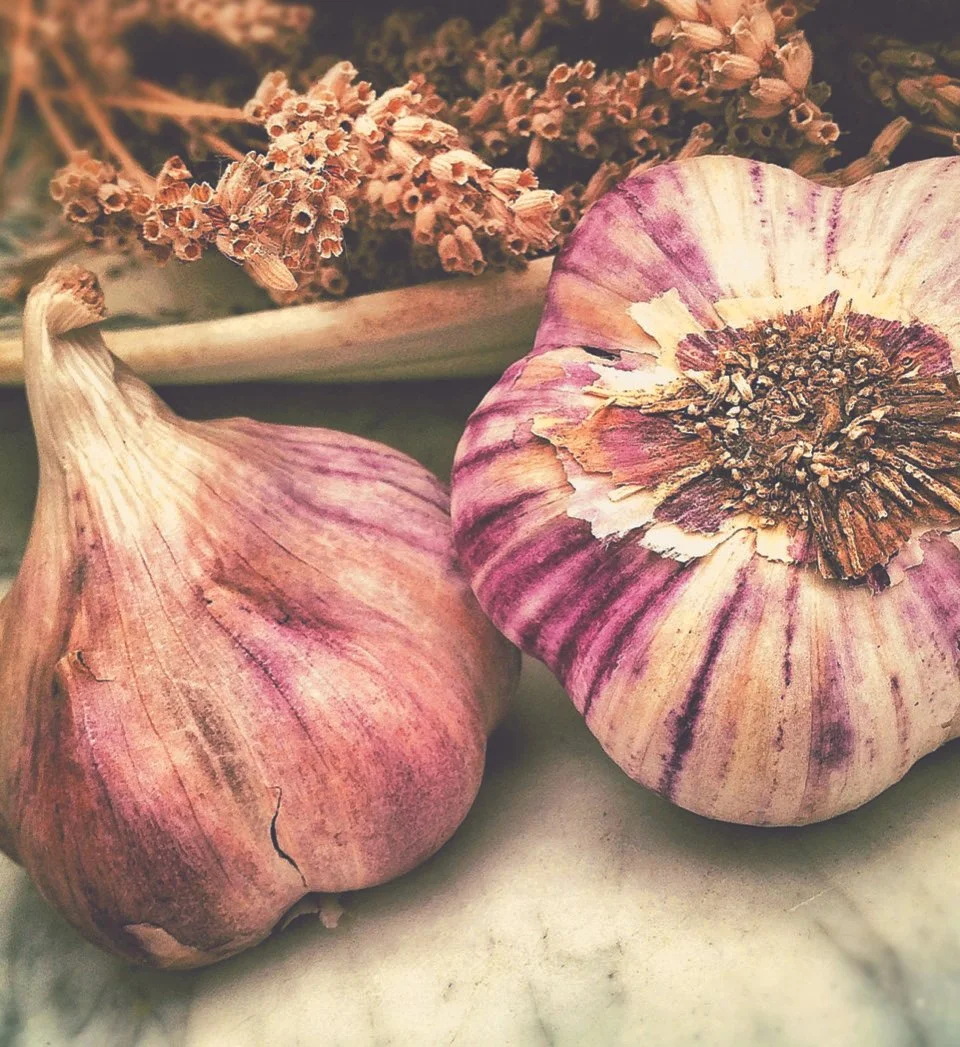
Image by Lobo Studio Hamburg, Pixabay
Thinking it a cheap antiseptic method, if a little odd, I was ready to assume a cauldron-stirring, macramé-knotting Mesopotamian mind, so I popped by the local kārum to collect a head of garlic.
I crushed a fresh clove to rupture its cell walls and release its aromatic oils. Anybody with working olfactory senses five rooms over would know what I was quietly up to. Next, I fought with its pithy bits, forcing them to sit on my skin and not fall off (the difficulty of which I should have taken as a stern warning sign), all in an attempt to clamp them down with first aid tape to my thumb.
Those in the allium know are thinking: why, why in blazes would you do this?
I spent the following week paying big for this haphazard behavior, like facing a high-interest credit card after reckless spending. It was a curious and tender experience, by turns, watching my thumb blow up.
It blistered, healed and finally peeled, like onion skin.
The drama began with the family kitty cat. The poor little guy had just been through the medical ringer at a veterinary clinic, including spending the night in a strange place, no routine-loving feline’s idea of fun. The dude is normally comical and chill, but he clearly felt pushed to his limits of patience.
I was helping to assist with a slightly invasive procedure, trying to keep a loving but firm grip on his scruff, when he finally had had about enough.
Quick as a flash, Mr. Mellow leapt up, wriggled free and gave me a “Hey, now!!” warning nip in my thumb. For such a little package, he sure held his own and expressed real cattitude against the three of us attending. There is a “cat map” meme out in the ether, illustrating where touching is ok and where it is off-limits, one that we surely had not consulted.
We backed away and let him leap down off the table. One side of my thumb revealed a tiny, temporary dent, no broken skin, while the other side suffered a superficial, shallow grazing.
No blood had been drawn. He could have done far worse; regardless, a bite from an animal is nothing to trifle with.
It was offered that I quickly wash with Betadine, encourage it to bleed (the bite was too shallow to draw any blood), slather on antibiotic ointment, wrap it initially, then stop at the store on the way home to buy a clove or two of garlic and fashion a poultice to leave on overnight.
Somehow, in the rankled fur of the moment, I only registered the word, “garlic.”
As for what happened next, don’t do what I did. Don’t go wrapping nature’s powerful plant kingdom directly over your skin like some cave-dwelling beast, unless you first sensibly educate yourself with the how, what and why. Don’t just do things on reflex. Read up. Ask a lot of questions.
For those like myself who’ve no poultice experience, that means your herbal remedy of choice first gets tucked inside layers of cheesecloth before being placed against your protected, well-oiled skin, to form a barrier.
I learned with startling clarity that prolonged, direct contact with crushed garlic doesn’t just inflame the skin; it leaves an autograph.
In my case, it began with stinging and inflammation; next, white spots; followed by small bubbles, becoming larger bubbles; and finally, hard, ragged pieces of dry skin curling up and gradually sloughing off. It interrupted a lot of things I tried to get done over the week.
A month later, everything looked normal again … but initially, there lingered a strange, slightly numb sensation in a few spots.
Basic, first-aid care directs us to properly wash and treat any wound or bite with antiseptic and antibiotic ointment, even if it only appears superficial, as well as monitor for redness, swelling, fever, or worsening pain. If the skin is punctured deeply, or the animal was a stray, or our tetanus/rabies status needs attention, we’re directed to get medical attention right away. These steps generally work well.
Maybe going forward, I’ll leave the garlic for spaghetti sauce.
The Rural Ethicist is a column about the culture of the daily mundane. It tolerates an occasional spider, values the bull in horse sense and seeks the gleaming, stainless steel wisdom beneath a film of cooking grease. Above all, it cherishes the gem of our shared existence: family. ruralethicstudio.com