
Deborah Sampson, American Revolutionary
By Katharine Adams
July 2026
On July 4, 2026, our nation will mark its semiquincentennial, a span of 250 years since the adoption of the Declaration of Independence in 1776.
A meaningful 250th anniversary celebrates the many people whose contributions shaped our nation’s continuing story, beyond the Founding Mothers and Fathers: enslaved and free Black Americans, challenging the incongruities between the ideals of liberty and slavery’s hard reality; Native American leaders, confronting increased pressure on their ancestral lands against expanding colonial settlements; and the vital contributions of women, who ran fundraisers, farms and businesses, provided logistical support as camp followers, served as nurses and spies, and some even disguised themselves as men to serve in skirmishes, mostly out on the open farm fields of the era.
One of the most well-documented stories of female military service during the American Revolution is that of Deborah Sampson, recognized as the American Revolution's only pensioned female veteran.
Born in 1760 in Plympton, a rural town in Plymouth County, MA, located 35 miles south of Boston, Sampson spent much of her young days as an indentured servant to the family of Deacon Benjamin Thomas (sometimes identified in various sources as Jeremiah Thomas) of Middleborough, MA. Sampson entered the Thomas household at around age ten, five years after the passing of her father, who was lost at sea. She remained in service between 1770 and 1778, until she could leave of her own will when she turned eighteen.
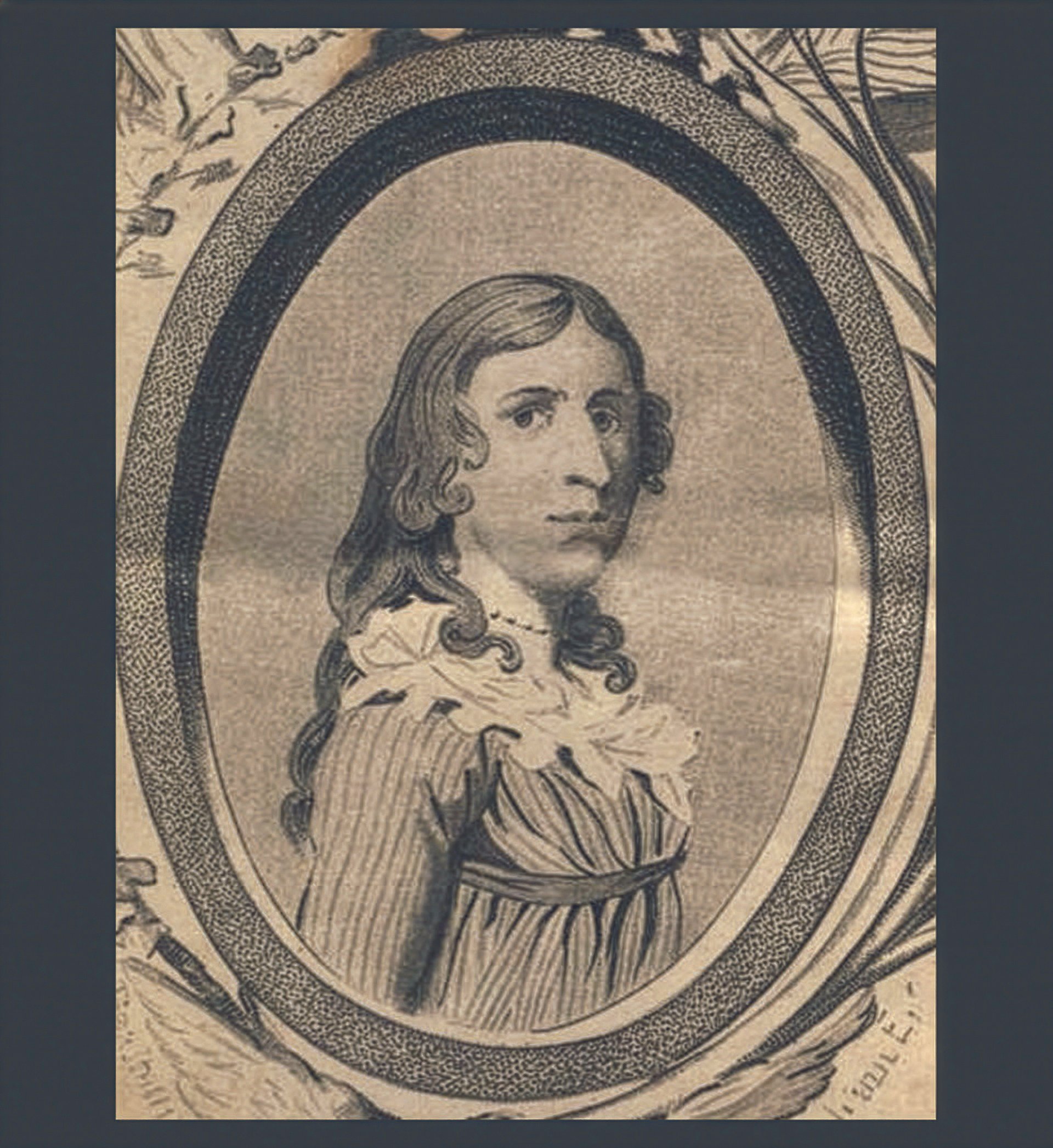
Image in the public domain: engraving by George Graham, from a drawing by William Beastall, based on a painting by Joseph Stone
As prosperous farmers, the Thomas family kept indentured workers, a common practice during the Colonial era. Primarily, youth performed both farm and household labor. In New England, indentured labor was often a way for immigrants to afford costly transatlantic passage. It was also a contract-enforced method of formalized apprenticeship.
While the Thomas children were formally educated, Deborah Sampson was not; however, she borrowed discarded schoolbooks from family members and dove headlong into learning. Her abundant belief in a better tomorrow, unwavering curiosity, and desire for a better standard of living found her carving out her future work as a school teacher.
For an individual of her social standing to dare try to get ahead, the times presented an extreme challenge. Living a life of exhausting manual labor—rising with the birds to do chores like plowing, milking cows, and weaving—she must have enjoyed precious little free time to pursue self-education. Additionally, the pursuit of letters for women during the time was deemed non-essential.
But Sampson was tenacious and fully literate by the time she reached 18. The Revolutionary War had begun two years earlier; she stirred to make a difference and joined the effort. Accustomed to strenuous physical labor and skills associated with “men’s work” during the eighteenth century appeared to help prepare her for military service, as she passed successfully as a male soldier when enlisting in May, 1782 with the Continental Army in Worcester, MA, where she served in the Light Infantry Company of the Fourth Massachusetts Regiment.
It is remarkable how insistent she was in trying to enlist.
“She first enlisted in early 1782 in Middleboro, adopting the name Timothy Thayer,” according to The Paul Revere House, “and then, after getting found out, tried again in Uxbridge that May, under the name Robert Shirtliff.”
She served under the name Robert Shurtliff, which has often been ascribed to a brother who had passed away. Surviving genealogical records do not substantiate the common hearsay, as none of her siblings show that name; but according to the American Battlefield Trust, Sampson “has a paper trail concerning her combat service in the army, where she fought under the alias of Robert Shurtliff, the name of her deceased brother.”
Under the command of George Webb, she served for two years with a concealed gender. She drilled and marched among her fellow soldiers and was assigned several dangerous missions, including scouting, driving successful raids, and spying. She braved her share of battle wounds, treating many of them herself, for fear of her identity being discovered. During combat in an area near Tarrytown, New York, she received serious injuries to her forehead and leg, and is widely said to have excised one of two musket-ball bullets from her own thigh. Other stories claim she suffered a dislocated leg.
Finally, in 1783, her formerly concealed identity was discovered when she became very ill with a fever while being stationed in Philadelphia. It was then that the physician treating her, Dr. Barnabas Binney, discovered her true identity. She received a full honorable discharge from the army by Henry Knox, despite her enlisting under a disguise.
On February 20, 1804, patriot leader Paul Revere recognized and supported her military service by personally petitioning William Eustis, Esq., Member of Congress, that Sampson be awarded a full military pension.
In the Online Library of Liberty, author Kirstin Anderson Birkhaug writes that “The United States Congress issued a statement which maintained that, apart from Deborah Sampson, the Revolution ‘furnished no other similar example of female heroism, fidelity and courage.’”
Deborah Sampson’s determination to educate herself and her bravery as a soldier blazed a path for generations of service members to follow. After she retired from service, she went on tour lectures regarding her military days, also earning respect as the first American woman to enter the public lecture circuit. The United States Armed Forces signed into law the Deborah Sampson Act, a mandate for improved benefits for women veterans, inspired by a true American revolutionary.
The Rural Ethicist is a column about the culture of the daily mundane. It tolerates an occasional spider, values the bull in horse sense, and seeks the gleaming, stainless steel wisdom beneath a film of cooking grease. Above all, it cherishes the gem of our shared existence: family. ruralethicstudio.com