By Eric Danfort, Chef @ Paige’s Place
March 2026
When I was asked recently about the many collections we have at Paige’s Place, it occurred to me just how many and how varied our collection of collections actually is. Before I realized how much work these collections were doing, there were signs of them everywhere—birdhouses, mobiles, gnomes. More seem to present themselves each day and in many cases these discovered collections were already there functioning, shaping the space and how people move through it. It was only later that I began to notice them for their presence, their inherent capacity for carrying meaning, and when and how they become activated.
Collections, as I’ve come to understand, don’t simply exist in a vacuum, but rather are constituted by the lives lived with them. This subtle distinction becomes visible over time, if it does at all. Objects, once gathered with care, may physically remain long after the relationships that gave them meaning have shifted. When that living relationship changes, so too does the nature of the collection. As people move on, attention shifts, use falls away—collections can persist without purpose, the objects themselves left loitering, standing ready as to be disassembled; decluttered. In those moments the objects haven’t changed but the meaning they carried has, as meanings tend to do.
At Paige’s Place, collections take many forms which, at any point in time, exist in different states of attention, use, and care: mismatched silverware in daily use; instruments hanging at-the-ready; bottles repurposed as vessels for collected feathers; origami displayed; mugs accumulating slowly overhead.
Some collections regain (and retain) meaning not through preservation, but through activation. This happens most clearly when useful objects move out of a display or decorative role and back into active use. Collections of kitchen tools and racks are added, replaced, or reconfigured as needs shift. Inherited ceramic creamers, once kept in a glass front display case, now circulate through service. A vinyl collection comes alive when someone chooses a record, drawing the room into a shared experience of listening. In these moments, meaning doesn’t return because the objects were saved, but because they are used—because they are brought into a relationship again.
The Paige’s Place Mug Club didn’t begin as a solution to a problem, but rather emerged as an opportunity—one that felt present in the space, waiting to be noticed. In a breakfast-lunch restaurant, mugs are among the most frequently handled objects. Mugs can carry a particular sense of intimacy. At home, they tend to accumulate, each one carrying traces of where it came from or who it belongs to. Envisioning an eclectic collection of mugs gathered overhead felt less like decoration and more like an invitation. The early structure was simple, practical: wooden pegs hung along a beam to hold whatever contributions arrived.
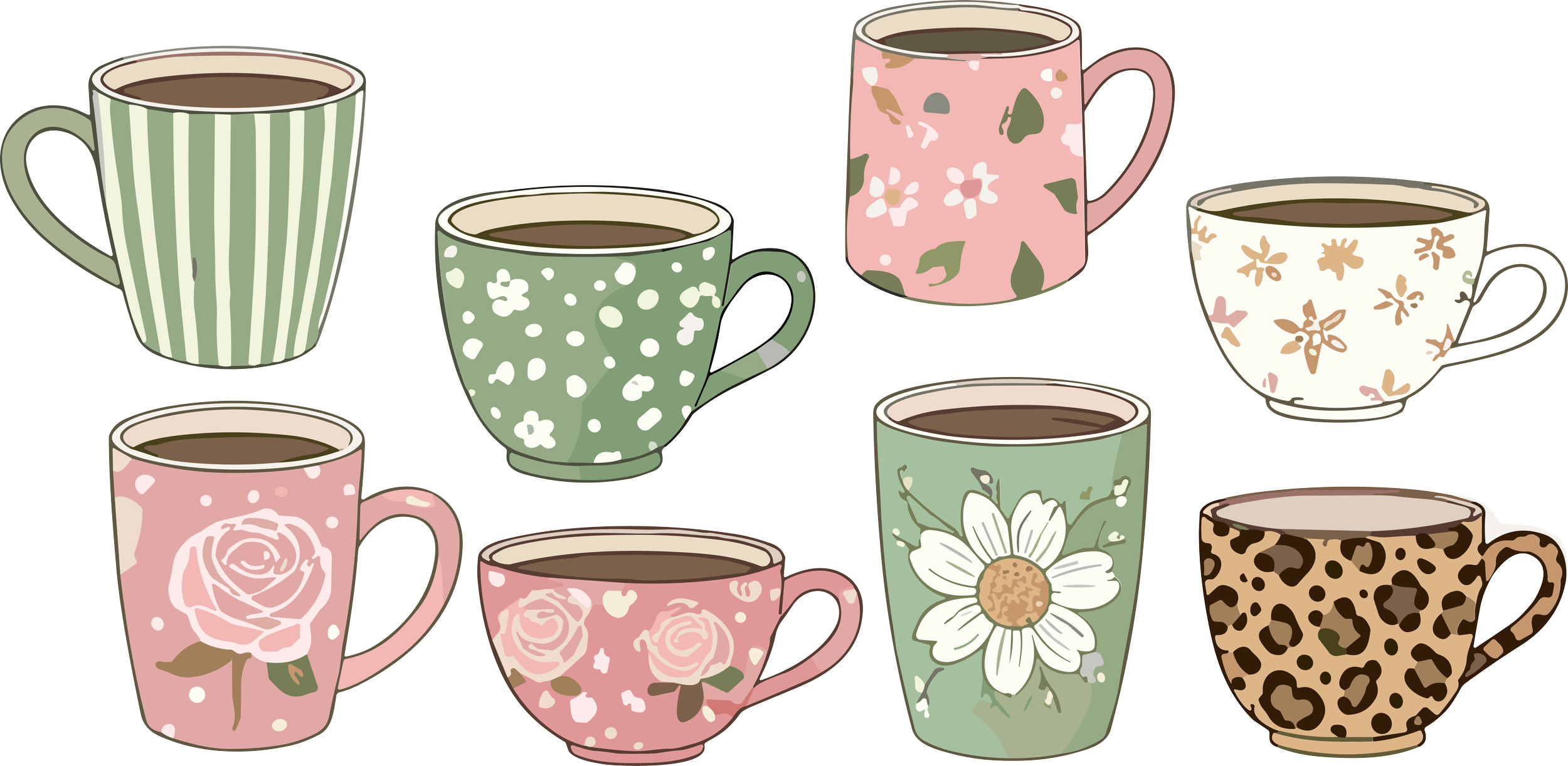
As members add their own mugs, variation across the collection becomes increasingly apparent. Over time individual mugs have begun to distinguish one from another; one is bright orange with blunt, humorous lettering; another is pink, adorned with “Elvis” rhinestone lettering. Others are quieter: a camping scene, a single-panel cartoon, a familiar ceramic shape revived from dormancy in a corner cupboard at home. None of these choices need explanation or introduction. They simply arrive, are hung, and take their place amongst the rest. In this way, the collection resists uniformity without becoming curated, allowing difference to exist without commentary. Each mug, in its specificity, stands in for its owner in their absence.
Care is evident in how the mugs enter the collection, and is so mirrored in how they are held in the restaurant flow once they do. They’re handled differently than the rest of the dishware: set aside rather than stacked, returned to their pegs with care. Not because they are fragile, but because they are held. Care in this sense isn’t something added to the system, but something that emerges from it, extending naturally from the relationships the collection makes visible.
The Mug Club is not an exception among our collections at Paige’s Place, but an expression of their broader patterns. Collections take shape, shift, and sometimes fall away as the relationships around them change. Some are built intentionally, others emerge slowly. Some remain in use, others recede into the background, waiting to be reactivated or released. What gives them life is not their permanence, but rather the way they are lived with over time.
The mugs overhead continue to accumulate, unevenly and without urgency. They don’t signal completion or membership in any fixed sense. They mark presence across time—who has been here, who returns, who is remembered even when absent. In this way, the collection remains open and unfinished, shaped less by design than by the relationships that give it life over time.