
A Bounty of Thankfulness
By Patricia Racine
November 2026
As the air turns crisper and the days unfortunately grow shorter, we find ourselves with more time to be contemplative. This is the time of year when the simple aspects of daily life take center stage, like sipping a creamy mug of hot cocoa, the mesmerizing light of a fire dancing in the wood stove, and the satisfaction we get from comforting food, like cheese. I, myself, am very thankful for that ancient shepherd trying that gloppy mess from his sheepskin pouch and beginning our love affair with cheese. Over time there have been several cheeses that changed the industry and how we enjoy our daily dairy.
Montgomery’s Cheddar has held fast to tradition when it comes to making their cheese. In a time when cheddar has become synonymous with perfectly shaped blocks wrapped in plastic, these cheesemakers have held fast to their original methods of cloth wrapped cheese. We are thankful for their farmstead artisanal high-end cheddar that sets the standard for other cheesemakers. Try this cheese grated over warm apple pie or crisp, a New England tradition.
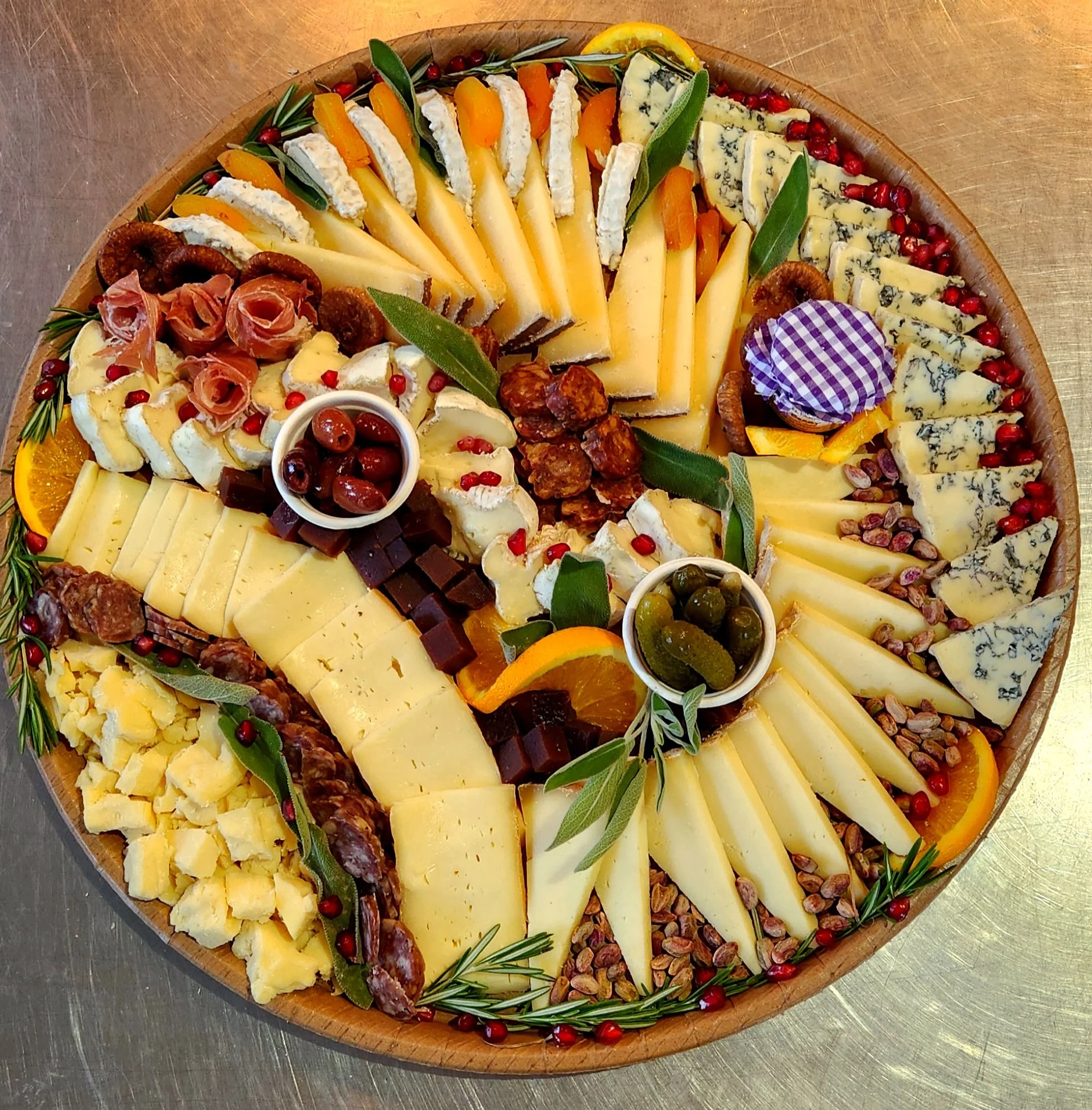
A board full of the bounty of the season. Photo taken and made by Patricia Racine
Brie de Meaux is globally important due to its 1,200-year heritage as the premier trailblazing bloomy rind cheese. Unlike the majority of “brie” which is pasteurized, highly processed, and saddled with a mild, basic flavor, Brie de Meaux holds onto its ancient recipe and standards,which result in a more complex flavor profile of earthy mushrooms, hay, and truffles, i.e., a little musty. This is a difficult cheese to get in the US due to our strict raw milk restrictions, but the creamery makes a pasteurized version for us called Fromage de Meaux. Try this version on a nice warm baguette with a dollop of cranberry-orange relish.
Vermont Creamery Fresh Chevre was created by Allison Hooper in 1984, back when goat cheese was unknown in this country. What makes it different is that it has a fresh, mild, and clean flavor instead of the usual barnyard notes most goat cheeses have. This creamery took an unknown style of cheese from France and made it a national phenomenon. Try the chevre on a gingersnap cookie with a drizzle of maple syrup for a seasonal treat.
Thanksgiving is the most food-centric holiday we celebrate; it is completely about food, family, and sharing the bounty of the season–oh, and a big parade on TV. In the cheese world this is the kickoff to our big season; between Thanksgiving and New Year's many a wheel will be cut and many a board will be charcuteried, but it wasn’t always like this–the first Thanksgiving was pretty much dairy-free.
First off, the Wampanoag people did not raise domestic animals for milk, they relied on game, fish, corn, beans, squash, and wild plants for food. Secondly, when the Mayflower set off for the new world in 1620, the only livestock cargo they carried were chickens, goats, and pigs. And while a few goats survived the voyage, they didn’t produce much milk in the autumn; no kids, no milk. The only dairy the Pilgrims ate in those early days were small amounts of fresh curd (cottage) cheeses, not enough for large, shareable wheels. That all changed in 1624 when the first English dairy cows, “Great Black Cow, Lesser Black Cow, and Great White Backed Cow” were led down the gangplank to begin the great American dairy story. We don’t have accurate records on the breed, but most historians believe these cows were most likely Kerry Cattle.
So, when you look around your family’s Thanksgiving feast, I hope you are thankful for the simple blessings of family and good food. That is the most important part of our lives; well, that and cheese.