
Helping Our Turtle Friends
By Katharine Adams
August 2026
Some weeks ago, driving south along Route 8 in Otis, I noticed a handmade sign reading, “Turtle Crossing, Slow Down.” The lettering was clean, the style charming, and the message in earnest. Somebody, clearly a nature lover, put time and effort into fashioning a sign that could hold up to the summer elements, with large enough print to be easily seen.
I know the feeling well to want to help a turtle cross the road. Whenever I see one poised for danger, everything comes to a stop. I pop my blinker on, pull over as soon as it’s safe, and make swift feet to help shield a turtle from daring trouble. It’s worth repeating to always help a turtle cross in the direction they are headed.
Some of the little guys sport impressive sets of claws. They will wriggle and paddle their feet while you lift them. In the Berkshires, small turtles (less than 8 inches) with such claws are typically adult male red-eared sliders and painted turtles, each a common, local aquatic species.
I always keep gloves, plus some sort of long implement, like a stick or shovel, to gently coax the larger ones across the road. Featuring powerful jaws and an aggressive defense, snapping turtles are a reptile I would not dare to get close to. They only take this occasional stance because their small bottom shell prevents them from fully retracting, so they must rely on their jaws when they feel threatened, which only happens while on land and during nesting season. Usually, a line of cars will slow, with someone experienced emerging to help. Plenty of information is online for those with snapping turtle knowledge and experience about using the “stick method” (letting them bite down on a long stick with their powerful jaws, then try to gently pull them along); the “wheelbarrow method” (nope, not me, not ever, never-ever); and the “car mat slide” (equally beyond my comfort zone).
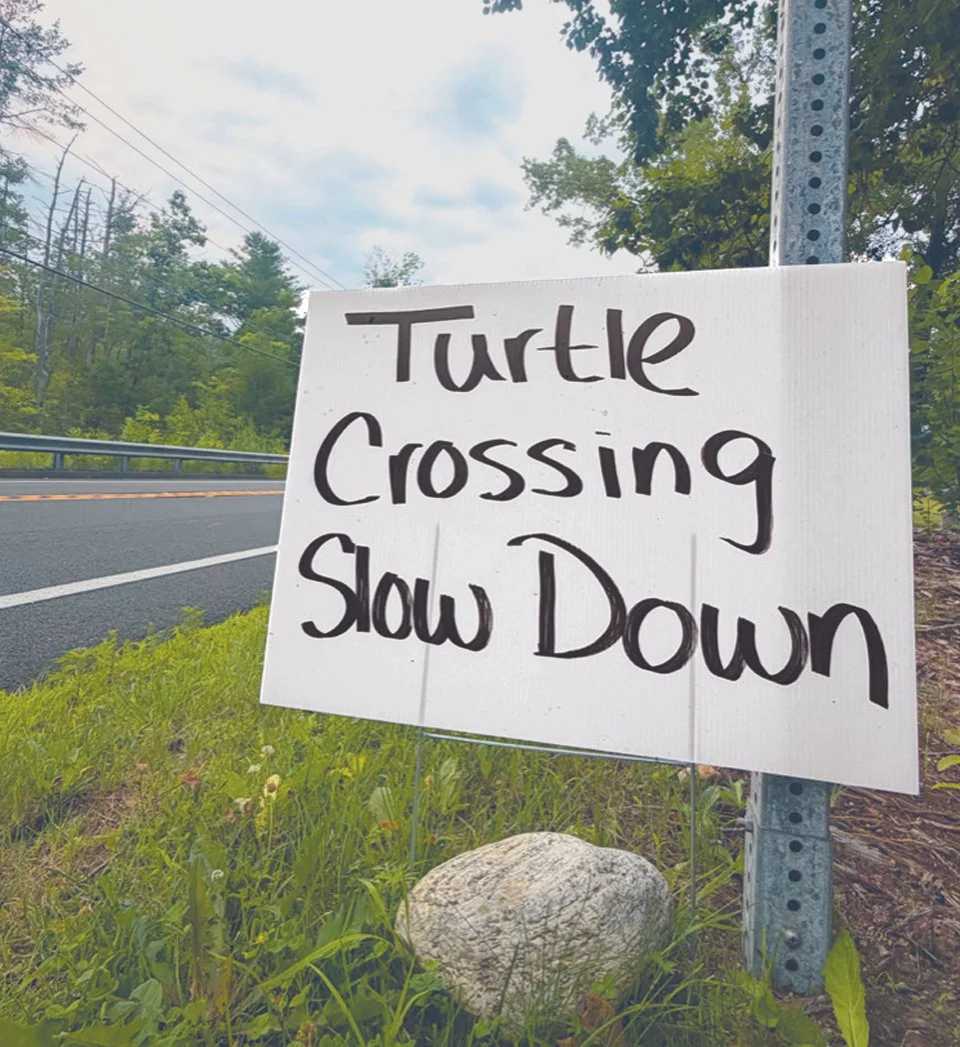
Photo of a sign by Tracy Zustra, licensed wildlife rehabilitator and founder of Berkshire County Turtle Rescue
I was itching to know who made those sweet, hand-written signs. I contacted friends at MassDOT and the Highway Department, who were also curious. Then, my mother told me she saw the same style of sign repeated elsewhere in the county. That revelation was a “bingo” moment, for I believed the signs were likely crafted by Berkshire County Turtle Rescue, the only wild turtle rescue clinic in Berkshire County, a non-profit organized in 2023. I had contacted them a few years ago about a little painted turtle I found in distress.
Finally, I called their number. Tracy Zustra, a licensed wildlife rehabilitator since 2011, answered my call right away, friendly and upbeat, even greeting me by name! Beyond helping turtles, she could host a class on people skills and phone etiquette, as she demonstrated the very mark of someone who loves what they do. She is so well-organized that she had saved my contact info, and even the type of turtle I had brought in.
We had a lively catch-up chat—and Tracy is, indeed, the maker of the signs. She is happy to provide her signs to all who ask for them throughout the county. In our case, a caring postal worker in a nearby town made the request. She recommends they be installed by mid-May, early in turtle nesting season, and then removed by mid-October, or the signs risk not surviving the winter.
The rescue mission receives many injured turtles each year. A great number of injuries are due to being struck by cars while attempting to reach their ideal seasonal nesting spot. Helping prevent or minimize these issues is why Tracy creates these alert signs. Similar awareness efforts exist elsewhere in Massachusetts, begun by local conservation volunteers who recognize migration patterns each spring. If enough data are collected, some towns will support and adopt official signage.
Berkshire County Turtle Rescue strives to “contribute to native turtle conservation by providing emergency treatment and rehabilitation to native wild turtles, egg incubation and release after rehabilitation, and education to the public.” Their mission states that “Every turtle is important! Their populations are rapidly declining due to habitat loss, getting hit by cars, predator attacks, kidnapping, and more.”
Exploring their Facebook page, with frequent turtle postings and photos, it is clear that Tracy is passionate about her work. Deeply knowledgeable about turtle shell repair and their overall well-being, her heart and soul belong to these charming, slow-moving creatures we share the land with. And her little pop-up sign served exactly as intended: I learned the swampy areas close to my property include active turtle crossing zones.
The good news is that a turtle’s shell is similar in composition to our own bones, and one that is fractured can often heal with protective care and rehabilitation. It is a myth that an injured turtle may be too bad off to crawl away; rather, their survival instincts are very strong and will eventually propel them to hide. Still, understand that such a turtle is suffering and needs professional attention. Tracy welcomes calls about any injured turtles.
As a 501(c)(3) tax-exempt nonprofit organization, BCTR relies on donations from the public. If you find an injured turtle, wish to donate, or are interested in becoming a wildlife rehabilitator, BCTR welcomes you to reach out! You may reach them at berkshirecountyturtlerescue.org, where there is a lot more information.
The Rural Ethicist is a column about the culture of the daily mundane. It tolerates the occasional spider, values the bull in horse sense, thrills over Latin botanical names, and seeks the gleaming, stainless steel wisdom beneath a film of cooking grease. Above all, it cherishes the gem of our shared existence: family. ruralethicstudio.com