
By Katharine Adams
September 2026
Nobody could ever accuse a rabbit of not knowing how to have a good time, judging by their sheer numbers this year.
Most friends report having seen at least one in their yard. I’m delighted to spy one almost daily. They adapt well when we maintain a reasonable distance, keeping a side eye on us as they sit and nibble grass. I become a pitchy chatterbox when I see one, cooing to it all singsong, as if tiny size should shape my delivery (always).
I wasn’t sure what type of rabbit we have on our property, so I pulled out my camera that happens to have a phone in it, posted a bunny photo, and trawled for replies on social media. Two friends suggested his name may be Jack, while others insist he’s a cottontail, and his name is Peter.
Locally, there are no jackrabbits among us; they live amid two dozen states across the central and western U.S. Here, we coexist with three lagomorphs: the eastern cottontail (Sylvilagus floridanus), most common; the snowshoe hare (Lepus americanus), much less common; and the New England cottontail (Sylvilagus transitionalis), the true native and most rare.
But why rare, this long-eared native sprinter? It is because the New England cottontail’s range has declined dramatically due to loss of suitable habitat, having been historically widespread.
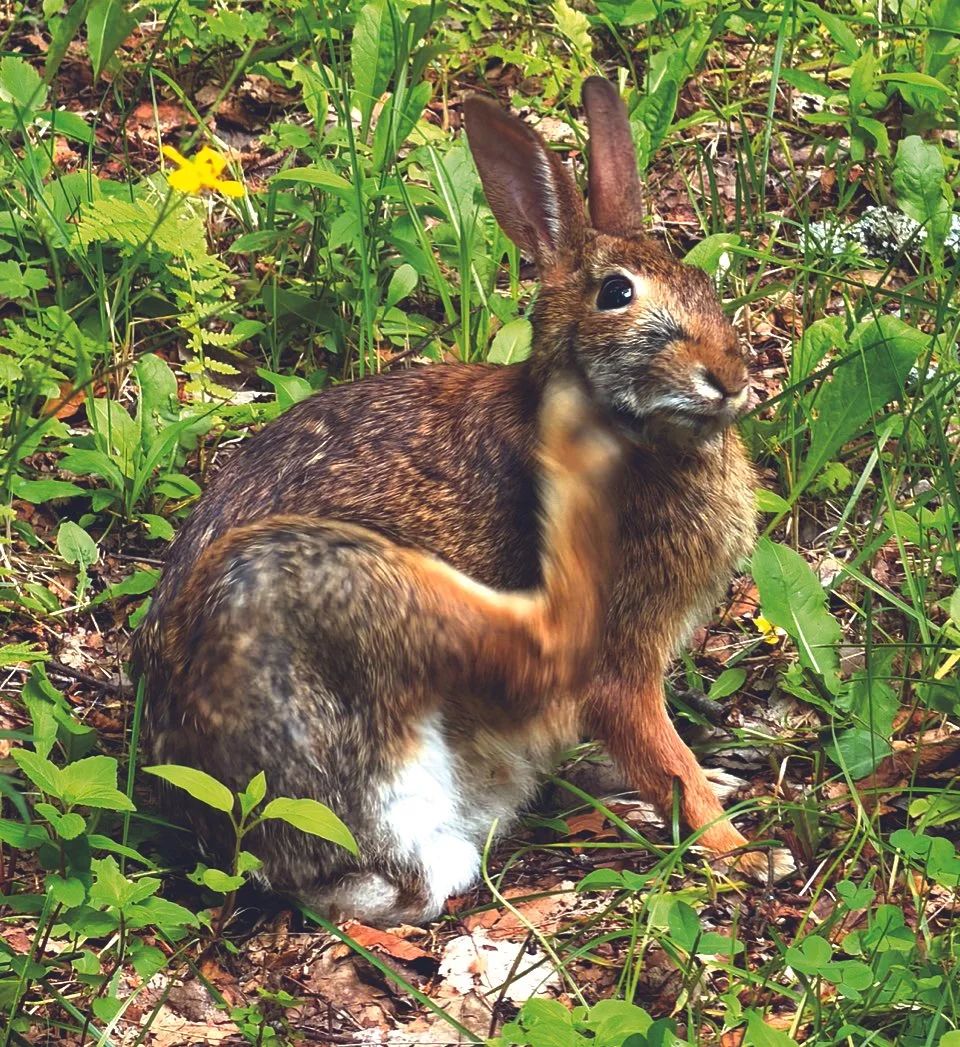
Photo of an Eastern cottontail scratching a little itch to go party, by Katharine Adams
Their ideal stomping grounds are very young forests, less than a quarter-century old. They thrive on constantly changing patches of young vegetation—dense, tangled shrubs, rather than mature and tidy woodland. Think fields left to fallow, sprouting into a thicket.
Abandoned farmland once served their habitat, which has largely disappeared, maturing into older forest. Conservationists work to recreate that preferred habitat through vegetation management. Good news: restoration efforts have been substantial enough that a federal listing under the Endangered Species Act for the native cottontail was deemed unnecessary.
Meanwhile, the snowshoe hare has earned its name as a winter snow expert. Featuring large hind feet, it can make extraordinary leaps to sprint across white fluff. It lives within a small range, preferring dense, young coniferous cover. Its brown summer coat turns white in winter, providing excellent camouflage; however, with snowfall unreliable, white hares against brown ground can be conspicuous to predators. Some southern snowshoe hares have adapted, retaining their brown coloration.
Finally, the eastern cottontail is the rabbit that most people encounter on lawns, near gardens, in fields, and thriving amid suburban neighborhoods. They are suited to landscapes that combine open, grassy areas for feeding with brush to escape for cover. Tender vegetation favored by cottontails during summer includes clover, dandelions, grasses, blackberry, raspberry, and wild rose. In winter, their diet shifts toward twigs, bark, and buds. Areas with dense young saplings and tangled edges support them best.
Most active at dawn, dusk, and nighttime, eastern cottontails and New England cottontails can be very difficult to distinguish, even by experienced observers. While the NEC is generally smaller and darker, with heavily furred, shorter ears, it is skull characteristics or DNA that are the surest methods to distinguish them from the eastern cottontail.
Our three local lagomorphs within the larger family Leporidae are exceptionally productive, due to mortality being exceptionally high. Breeding season begins February-March, extending into early fall, producing several litters within a single season.
Unlike newborn cottontail kits, born blind, smooth, and helpless, a baby snowshoe hare leveret is born highly developed, with open eyes. Each group gains some independence by roughly four weeks.
Hares and rabbits cannot breed together because they belong to different biological genera (Lepus vs. Sylvilagus), with a different number of chromosomes (hares 48, rabbits 44). And neither are Leporidae rodents.
With plenty of predators—raptors, foxes, coyotes, bobcats, and weasels—a rabbit that can vanish into tangled young growth is a hard catch. As a first defense, they often freeze motionless to avoid being noticed; but if discovered, they sprint and disappear. Cottontails typically run in zigzags, making hot pursuit challenging.
We can get attached to regularly visiting creatures in nature, and feel compelled to help them survive as harsh winter approaches. There are ways to help nurture our neighborly relations without helping too much.
Although tempting, don’t feed rabbits processed human foods, like bread. It can attract predators, creating other problems. Rabbits naturally transition from summer greens to winter bark and twigs. The surrounding native vegetation and natural browse are their best winter resources.
Using a “hands-off” approach, the best principle is to think habitat—not intervention. MassWildlife suggests one to two brush piles per acre, as a general management guideline.
For a low-intervention approach, Mass.gov guidelines recommend placing a few substantial limbs on the ground, near the woodland edge; top with loose branches, creating tunnels and gaps. Avoid making a solid heap. Leave dense, tangled areas, where possible. American mother rabbits make concealed, shallow “forms,” rather than a burrow system (as do European rabbits). Never disturb a suspected nest, except for a genuine wildlife emergency that needs professional assistance.
Nature is a wise teacher. Sometimes, the kindest thing we can do for wildlife is resist the human instinct to tidy up.
The Rural Ethicist is a column about the culture of the daily mundane. It tolerates the occasional spider, values the bull in horse sense, thrills over Latin botanical names, and seeks the gleaming, stainless steel wisdom beneath a film of cooking grease. Above all, it cherishes the gem of our shared existence: family. ruralethicstudio.com