Love, Mud & Snowdrops

By Katharine Adams
April 2026
April arrives, still chilly, but bringing light and a natural levity. People and animals emerge to blink in frank sunlight, looking to reconnect. Birdsong is more noticeable. Parking lots buzz with activity as motivated people run errands in shorts and shirtsleeves.
Emerging from mud season, a brief time I love for its promise of renewal despite its inconvenience, April reintroduces a handful of balmy days, along with some grateful moments to pause and take it in. Finally, after the hard work of winter, a respite. The rakes may come out and soil-toil begins, but it’s all in an effort to encourage the next season, not keep it at bay.
Mud is still kind of fun, like it was when I was a kid, as long as there are good doormats. On behalf of all committed, transition-season floor-keepers among us, we must be especially attentive to that loyal, unwavering, most humble public attendant: the tireless welcome mat. Pause to show it some love, for it likes a good back rub from a shoe. It’s a display of mutual appreciation. An effective performance is not unlike a chicken-scratch dance. (You can even ham it up and cluck, as a honing exercise opportunity for fellow mimics.)
Beyond all that, mud season lends a good excuse to stomp around and cross puddles in my frog-green rubber boots. Simply, my “frog boots.” I think I appreciate their fine company as much as my coffee maker. That’s saying a lot.
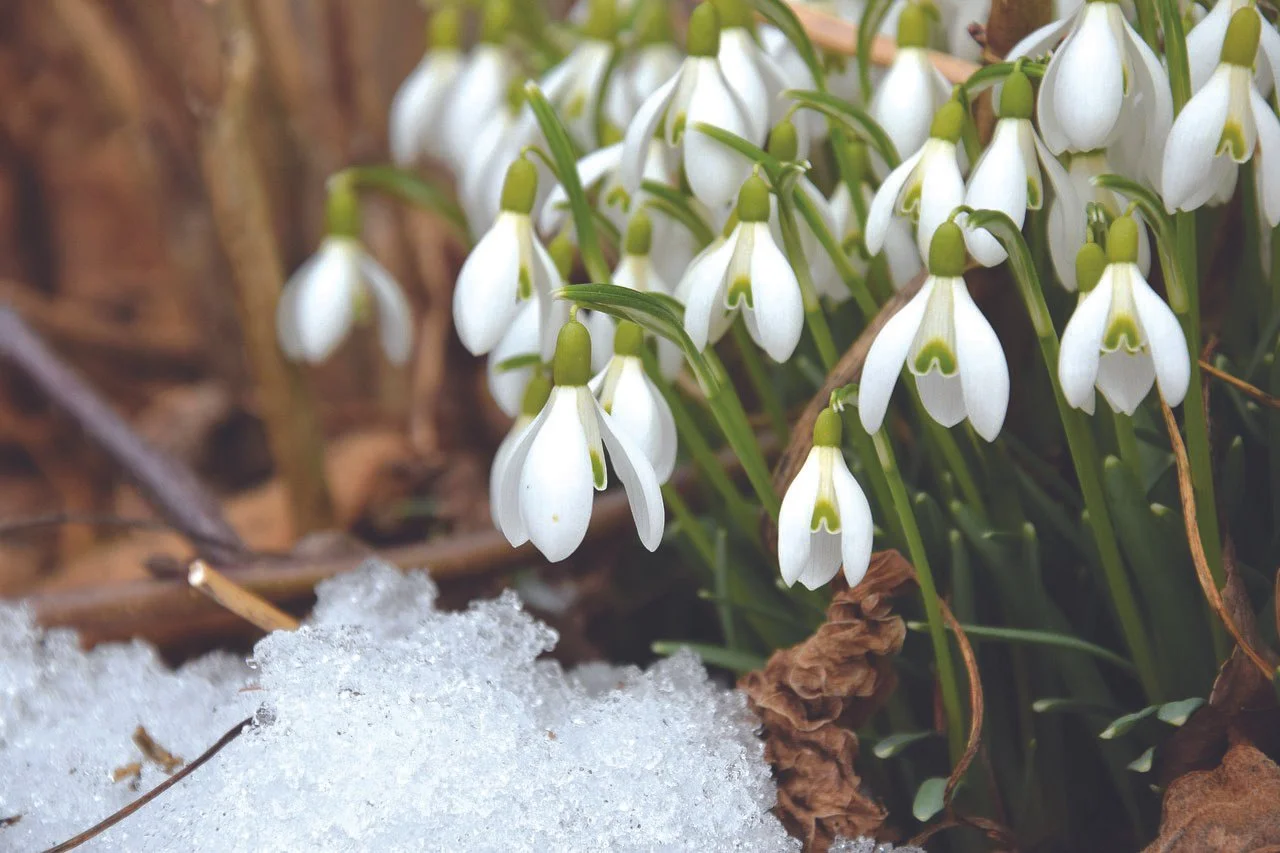
Snowdrops. Photo: Image by Georg Satzinger from Pixabay
But now with mud season having wound down, April brings the promise of further blossoms on the way. And it all begins with the humble snowdrop.
Often taken as the first sign of spring, snowdrops emerge in March (and sometimes, as early as February) to herald the next season’s arrival, followed closely behind by the appearance of crocuses. Conditions permitting, either may still appear in April.
Snowdrops (Galanthus) are tiny, cold-appreciating, bulbous perennials, oddly belonging to the tropical amaryllis family. Their scientific name means “milk flower.” You can recognize them by their white, bell-shaped flowers that pop up through the melting snow. You may need to search for them, but once they come into view, they seem to lift any mood.
“Where flowers bloom, so does hope,” remarked Lady Bird Johnson. Which is something the snowdrop is associated with, and that the world could use a lot more of.
As Alpine plants, native to the high-altitude terrain of southwest Asia and Europe, snowdrops are built to thrive in the cold. They only appear delicate, but are actually comprised of tough stuff: their natural antifreeze proteins—specifically, glycoproteins—live within their tissues to protect their cells. These proteins are polypeptides that bind to small ice crystals, preventing them from damaging the plant’s cells. With this special protein immune booster to protect against freezing temperatures and insects (and containing the natural armor of lectins), they are a highly resilient perennial that can freeze solid in winter, yet “wake up” and recover as temperatures rise.
Beyond this amazing feat, their pointy, spear-tipped leaves can nudge their way up through frozen ground.
The plant extract galanthamine was originally derived from snowdrops to treat mild-to-moderate Alzheimer’s disease. As a cholinesterase inhibitor, the extract enhances memory and cognition by increasing acetylcholine levels in the brain, as noted by the National Institutes of Health. The inhibitor has a modest effect, but it is used globally. Recently, galanthamine has been extracted from other members of the family Amaryllidaceae.
Still, the snowdrop plant itself is toxic and cannot be consumed in its natural state.
Early European settlers introduced snowdrops to New England for their early spring blooms. They escaped cultivation and became naturalized, forming large, mutually supportive colonies that spread across meadows and lawns through bulb division. Their densely packed clusters suggest a survival strategy that relies on that magic sauce of healthy cooperation known as teamwork.
They are said to start appearing in February in parts of New England, but begin with our Siberian-style load of the frozen white stuff burying everything here in Otis, we only began to spy snowdrops towards mid-March. These resilient bulbs can persist well into the first few weeks of April. Local weather conditions influence how long they endure: a rapid warming effect can trigger them to nod off and fade back earlier. At the same time, persistent cool temperatures can persuade them to bloom a bit longer.
The little snowdrop is a model of persistence and strategic cooperation. Within the larger ecosystem of a shaded woodland, it blooms amid harsh conditions by adapting to change. (In our human, tech-evolving world, it’s not unlike “pivoting” skills for job-seekers.) This adaptation demonstrates flexibility: a snowdrop knows to keep its petals shuttered to pollinators until temperatures warm enough to lift its face. Until then, a snowdrop points its petals downward in colder weather to protect its reproductive system.
These hardy little flowers are deer-resistant, and in our experience, maintenance-free. They’re like a surprise gift showing up each year, reminding us that balmy days are coming.
And like the best things, they contain comedy–for they crack us up with their fetching “tough-guy” stance, being tiny flowers absurdly situated alongside dense mud and sharp, gritty snowbanks.
“The earth laughs in flowers,” wrote Ralph Waldo Emerson, suggesting with his poem Hamatreya that while nature celebrates its cyclical permanence, those strident humans who claim ownership are comically fleeting.
Finally, snowdrops may be tiny and seem insignificant, but the smallest beings and gestures among us can contribute mightily to a bigger picture of balance.